| # | Track Title | Duration |
|---|---|---|
| 1 | Pharaoh's Dance | 20:05 |
| 2 | Bitches Brew | 26:59 |
| 3 | Spanish Key | 17:04 |
| 4 | John McLaughlin | 4:22 |
| 5 | Miles Runs the Voodoo Down | 14:00 |
| 6 | Sanctuary | 10:54 |
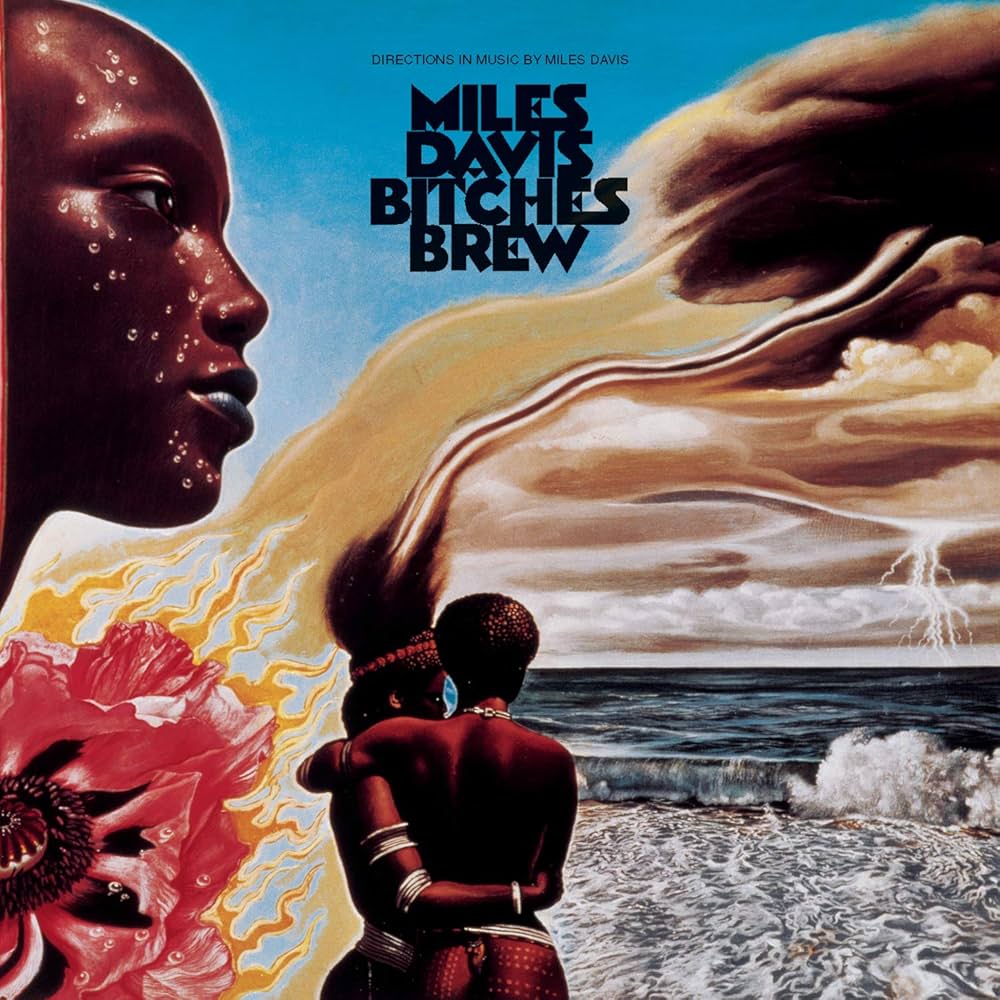
Davis arrives at the session after In a Silent Way with the declared intention of breaking down every remnant of traditional jazz form through electricity and studio editing. Producer Teo Macero records hours of collective improvisation with an ensemble that includes three electric keyboardists (Chick Corea, Joe Zawinul, Larry Young), two bassists, multiple drummers and percussionists simultaneously, and John McLaughlin's electric guitar—then he reconstructs the tracks in the editing phase by cutting, looping, and layering the tapes, a compositional method borrowed more from musique concrète than from conventional jazz production. Pharaoh's Dance opens the album with an electric groove that builds through the accumulation of layers, without a linearly stated theme—the structure emerges from the editing rather than the writing. The title track alternates sections of near-rock electric intensity with sparser passages, featuring Davis's trumpet treated with echo and electronic processing, a sound that consciously departs from the acoustic timbre upon which he had built his reputation over the previous fifteen years. Spanish Key works on a modal progression repeated almost obsessively, over which the musicians alternate in improvisational passages that Macero's editing selects and reassembles from different takes. The connection to Kodwo Eshun lies in the compositional principle even before the genre: Eshun reads Afrodiasporic electronic music as a speculative technology capable of producing alternative futures, and Bitches Brew applies this exact principle to jazz—a deliberate technological rupture, in which the recording studio itself becomes a compositional instrument on par with the trumpet. The album treats jazz improvisation and electronics as interchangeable materials to be spliced together, anticipating by method (though not by sound) much of the sampling and editing practices that electronic music would make standard decades later. Bitches Brew sells over half a million copies, an exceptional commercial achievement for jazz at the time, and paves the way for the fusion movement that would dominate much of the following decade—while remaining, unlike much of the slicker fusion that would follow, an album that still prioritizes density and challenging listening over accessibility.
L'IA sta riascoltando l'album per te...