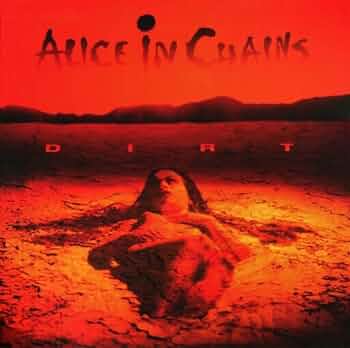
The Seattle band's third studio album, recorded during a particularly acute period of heroin addiction for singer Layne Staley and guitarist Jerry Cantrell, who wrote most of the lyrics documenting that condition without metaphorical filters. The record works with a heavier, darker sonic framework than its predecessor Facelift, with down-tuned guitars and a production (Dave Jerden) that leaves room for long, almost sludge-like instrumental sections, while the vocal harmonies between Staley and Cantrell — the band's most distinctive trait — remain intact even in the most disturbing moments. Junkhead approaches addiction in a tone that's almost celebratory and disturbing at once, a lyric describing heroin as belonging to a community rather than as individual ruin. Rooster, written by Cantrell about his father's experience as a Vietnam veteran, alternates a clean, almost folk arpeggio with a heavy chorus, while Down in a Hole slows the tempo down almost to stillness, with Staley singing a lyric about emotional dependency in an almost whispered register. Angry Chair, among the last songs Staley wrote for the record, describes the dissociative state produced by addiction with clinical precision. The connection to Reza Negarestani here lies in how the album treats addiction as a self-sustaining system following a coherent, almost ontological internal logic — exactly the principle by which Negarestani treats his own conceptual objects (oil, artificial intelligence) as entities that self-realize through their own internal logic, regardless of any external intervention meant to correct them. Dirt functions as a document of a closed system — addiction — observed from within, without the critical distance that would allow for easy moral judgment. Dirt remains the band's best-selling and most influential album, released the year before Kurt Cobain (whose Nirvana already features in this catalog with In Utero) explicitly cited Alice in Chains as one of the bands that had most affected him during that same period, and the record that permanently fixed the band's public image around its own self-destruction — Staley would die of an overdose eleven years later, in 2002.
L'IA sta riascoltando l'album per te...