| # | Track Title | Duration |
|---|---|---|
| 1 | Opening | 6:24 |
| 2 | Floe | 4:56 |
| 3 | Islands | 6:15 |
| 4 | Rubric | 3:59 |
| 5 | Facades | 6:23 |
| 6 | Closing | 5:36 |
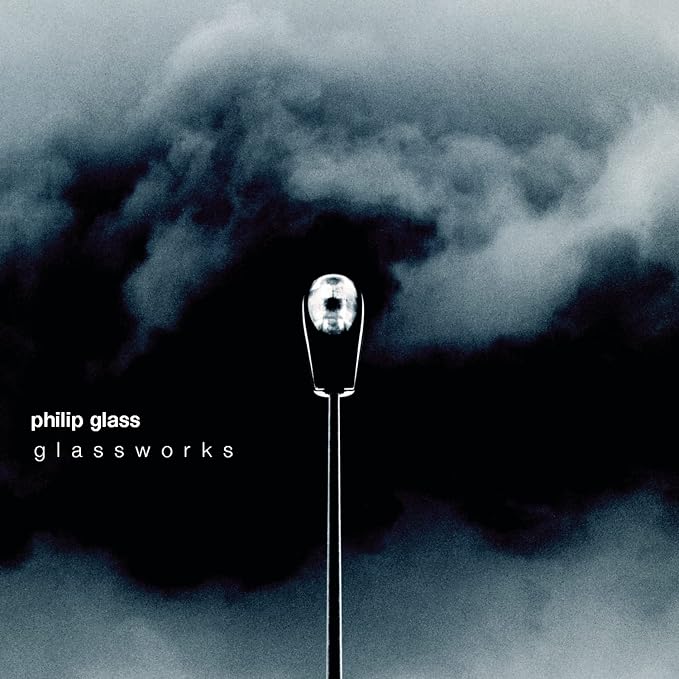
Released by CBS in 1982, Glassworks was conceived with an openly commercial intent: to move Philip Glass's minimalism out of the concert hall and into the home stereo, in a format explicitly designed for headphone or domestic listening. The composer reassembles material from earlier works and film scores (some of which would feed into the imagery of Koyaanisqatsi) into six short movements, each built around a single rhythmic-harmonic cell developed through accumulation. The technique is the so-called additive process: a minimal melodic figure is repeated and slightly altered with each cycle, adding or subtracting a note, shifting an accent, gradually displacing the listener's perception. On "Opening," solo piano lays out the principle almost pedagogically; "Floe" and "Rubric" transfer it to an ensemble of winds and electronic keyboards, with a more mechanical energy; "Facades" slows the tempo and introduces soprano saxophone in a more melodic, almost elegiac phrasing. What makes Glassworks an interesting object is not its accessibility — though that accessibility did help make it Glass's best-selling record — but its nature as a closed, self-generating system. Each piece functions like a small automaton: simple rules, repeated with near-obsessive precision, producing a perceived complexity greater than the sum of its parts. This is music that doesn't "tell" a story in the traditional sense, but stages one through a process observed as it happens. This logic of differential repetition — never quite identical to itself, never entirely new — connects naturally to Deleuze and Guattari's reflections on becoming and on repetition as a productive force rather than mere reiteration of the same, a theoretical thread present in the site's dossier on the two authors. It's not a link the record claims for itself, but it's hard to listen to the phased structure of these pieces without thinking of a system generating difference through the iteration of an identical pattern. More than forty years on, Glassworks remains an entry point rather than a peak in Glass's output, but that is precisely what gave it its historical function: it made scored minimalism a listenable language outside academic circuits, paving the way for decades of hybrids between repetitive music, ambient, and electronics.
L'IA sta riascoltando l'album per te...