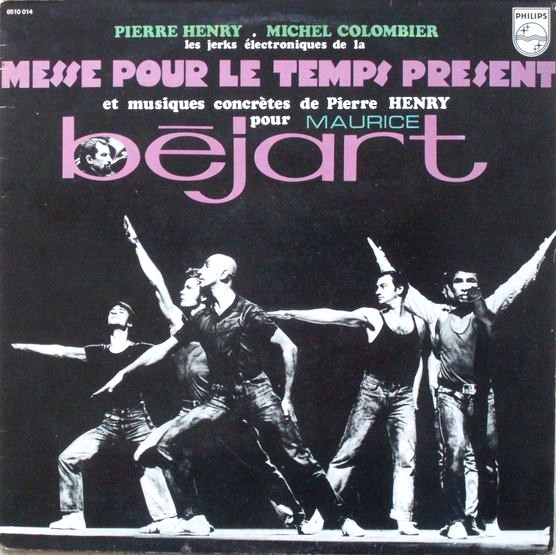
There is a misunderstanding that has accompanied Messe pour le temps présent since 1967, and it is the same one that secured its success: this is not “pure” musique concrète. It is a commission for a ballet, designed to be danced and consumed in a spectacular context, and its historical importance—along with its limitation—lies precisely in this hybridisation. Pierre Henry, by then already a central figure in musique concrète alongside Pierre Schaeffer, collaborated with Michel Colombier—a pop arranger known for his work with Gainsbourg—on the rhythmic material, and with Maurice Béjart, who choreographed the eponymous ballet. It premiered at the Avignon Festival in August 1967 . The result is a handful of “electronic jerks” blending discotheque groove, bass and drums, and tape-manipulated noise. Psyché Rock is the track that has crossed the decades, but it is not the only moment that works: Jericho Jerk and Too fortiche still function as strangely alienating rhythmic objects, suspended between go-go and avant-garde . The critical issue, however, is another one. Heard today, Messe pour le temps présent reveals an unresolved tension between two souls: on one side Henry’s electroacoustic writing, which surfaces at times with violence and density; on the other Colombier’s pop scaffolding, which tends to smooth over and make “palatable” what musique concrète held most radical. This is not a failure of execution but of design: the record was made to appeal to a broad audience, and it succeeds. Henry himself had an ambivalent relationship with this success, calling it his “Boléro”—a work that made him famous to an audience perhaps unprepared for the rest of his output . The remastered CD edition, which often includes Variations pour une porte et un soupir as well, allows one to measure the distance: there, musique concrète reveals its structural power without reassuring rhythmic mediation . Messe pour le temps présent, by contrast, should be heard for what it is: a document of an unrepeatable moment when the French avant-garde flirted with mass culture without fear of getting dirty. It is not the summit of musique concrète, but it is one of its most successful and historically decisive points of contamination. For first-time listeners approaching Henry, it is an honest entry point—provided they do not stop here.
The AI is relistening to the album for you...