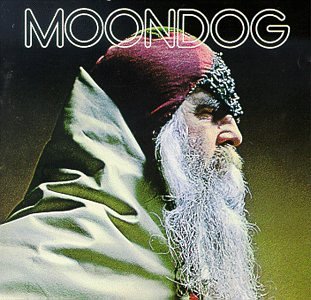
There is a paradox running through this record worth stating upfront: Moondog (1969) is the album that turned a blind street musician with a Viking helmet and a life on the margins into a respectable Columbia Masterworks artist. It is also, in many ways, the least "strange" record in his catalogue. Anyone expecting the radical avant-garde of his 1950s work will find a different Moondog here: orchestral, accessible, even elegant. The critical question is not whether it is a masterpiece—it is, in its own way—but what kind of masterpiece it is. Context helps. After more than two decades of independent activity, records for smaller labels, and a reputation for eccentricity that threatened to overshadow the music, Moondog signed with Columbia in March 1969 . The album, produced by James William Guercio (already working with Blood, Sweat & Tears and Chicago), placed him at the head of some forty musicians, with a lineup including Ron Carter on bass, Hubert Laws on flute, and George Duvivier . The result is a hybrid that evades categories: third stream for those who like labels, but really just Moondog doing what he had always done, with larger means. The tracklist alternates between moments of real power and others that feel more illustrative. Theme opens with a percussive march that functions as a manifesto . Stamping Ground is the best-known piece, built on a four-note descending ground and a progressive densification of material that anticipates the American minimalism of Reich and Glass . Lament 1 (Bird's Lament) is a chaconne for Charlie Parker, saxophone to the fore, its melancholy never sliding into sentimentality . Symphonique #3 (Ode to Venus) is perhaps the album's most lyrical moment, the solo violin dancing over an orchestral fabric that is surprisingly light . And Witch of Endor, the longest track, is also the most ambitious: three movements, Anatolian inspiration, a ballet originally intended for Martha Graham . The limitations, decades on, are evident. Minisym #1 in particular was criticised from the outset for a recording that does not do justice to the writing . And more broadly, the album suffers from an unresolved tension between symphonic ambition and the brevity of the pieces: some of the Symphoniques feel like studies rather than completed movements. Contemporary reception was nonetheless overwhelmingly positive, with New York describing simplicity and subtlety combined with spontaneity, and Variety stressing the album's seriousness . Pitchfork, more recently, wrote that the album absorbs "the essence of an era while peering beyond it" . That is the right formula: Moondog belongs to 1969 without being imprisoned by it. The real critical issue, however, is another one. This record made Moondog famous to an audience perhaps unprepared for the rest of his work, and helped fix the image of the "Viking of Sixth Avenue" as a character before a composer. Heard today, Moondog works better as an entry point than as a summit. It is refined, well played, full of melodic ideas that stay with you. But it is also, in places, too well-behaved for an artist who had made rhythmic irregularity and timbral invention his signature. The more radical Moondog is elsewhere—in the 1950s records or the German recordings of the 1970s. That said, it would be unfair to dismiss it as a compromise. Bird's Lament alone justifies the listen, and Stamping Ground is one of those pieces that continue to live outside their context—in The Big Lebowski, in Mr. Scruff's sets, in the collective memory of people who do not even know where it comes from . Moondog is not the record that defines Moondog. It is the record that made him possible for a wider audience, and for that it should be heard with gratitude and a measure of suspicion.
The AI is relistening to the album for you...