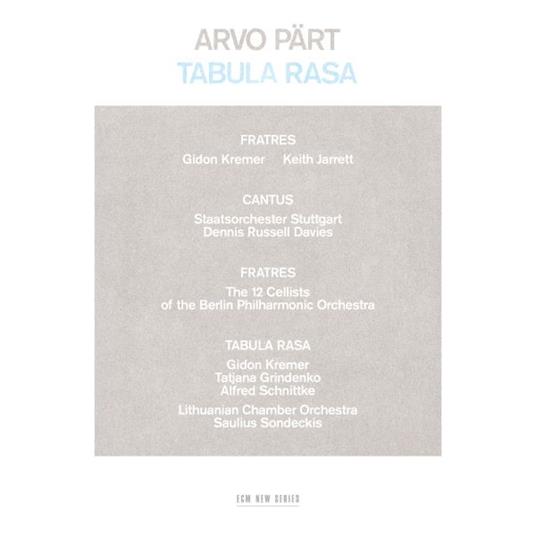
| # | Track Title | Duration |
|---|---|---|
| 1 | Fratres for Violin, Strings and Percussion | 10:24 |
| 2 | Cantus in Memory of Benjamin Britten | 6:34 |
| 3 | Tabula Rasa (Ludus) | 9:03 |
| 4 | Tabula Rasa (Silentium) | 15:03 |
Tintinnabuli is a minimal system: one voice moves by step, while the other remains anchored to the triad. Pärt had developed it just a few years earlier, following a long compositional silence spent studying Gregorian chant and Franco-Flemish polyphony. The result sounds like the extraction of a rule that precedes style itself—something that might have always existed, merely waiting to be noticed. Fratres opens with a progression that repeats over a fixed pedal point, altering only its harmonic voicing: the exact same concept runs through the entire record in different configurations (here, for violin, string orchestra, and percussion). Cantus in Memory of Benjamin Britten works on an even sparser principle: a single bell and a descending string canon that slowly converge toward unison, never ceasing to move away from one another until the final bar. The title track, split into Ludus and Silentium, juxtaposes the two opposing registers of Pärt's writing: rhythmic play and near-immobile suspension. It is an album that aligns seamlessly with the concept of hyperstition: a minimal formal structure—a few rules, executed with almost mechanical rigor—that generates, through accumulation, an effect far exceeding the means used to build it. It operates as a self-executing system that, through its performance, produces an emotional state that the system itself did not originally contain. Pärt's religious faith and the austerity of his language function as a device: the literal repetition of a few harmonic cells ends up generating a sense of a threshold—of something opening up beyond the surface of the sound. Xenomelody. Recorded with Gidon Kremer, Tatjana Grindenko, and Alfred Schnittke under the direction of Eichenholz, alongside Keith Jarrett himself on piano for a couple of tracks, the album remains a touchstone for understanding how European minimalism (distinct from the American school of Reich or Glass, as it is less percussive and more deeply tied to sacred tradition) can generate intense power using almost ascetic means.
L'IA sta riascoltando l'album per te...