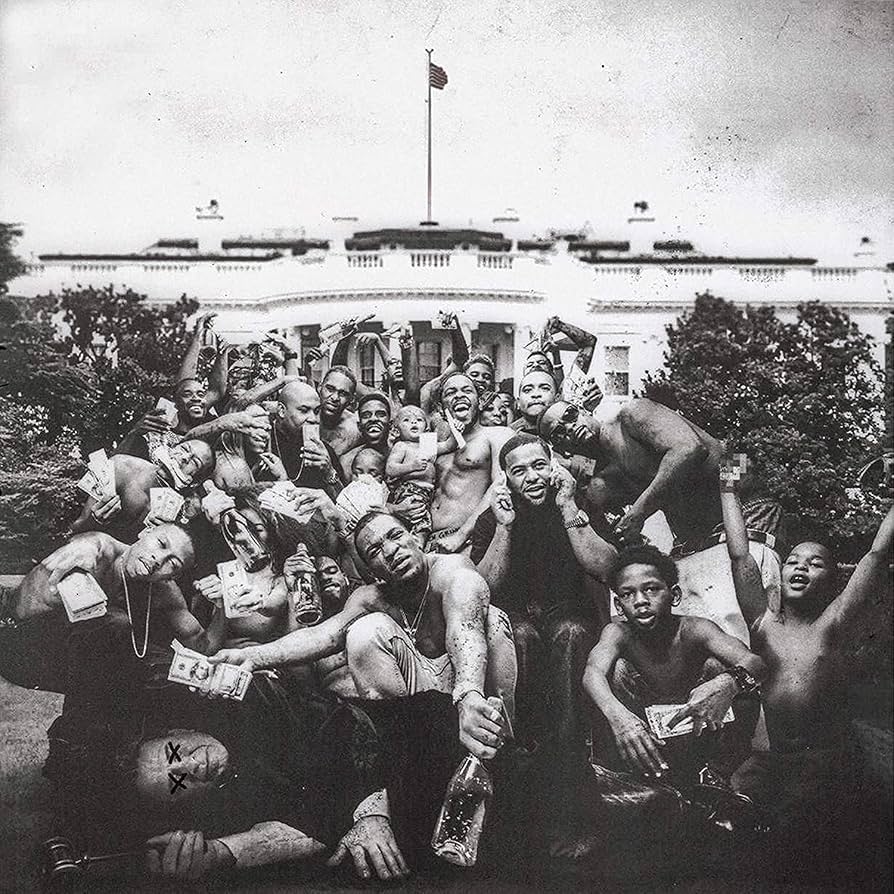
Kendrick Lamar's third studio album, recorded with an ensemble of live jazz and funk musicians — Thundercat, Kamasi Washington, Robert Glasper among others — instead of the digital sampling prevalent in contemporary hip hop. The record builds a single narrative across its sixteen tracks, closed by a poem that Lamar recites and progressively expands track by track, until it's revealed in the finale as a letter addressed to Tupac Shakur, reconstructed from an archival interview in which Lamar appears to converse with an artist who had been dead for almost twenty years. Wesley's Theory opens the album with a Boris Gardiner sample run through an almost psychedelic funk bassline, while King Kunta builds an almost James Brown-style groove over a lyric claiming artistic authenticity against the record industry. u, among the most exposed tracks on the record, stages a psychological breakdown in near-real time, with Lamar's voice distorted and fragmented to the point of losing coherence, while Alright, the best-known single, became almost immediately an anthem of the Black Lives Matter protests — a collective appropriation Lamar hadn't anticipated but which the album, by thematic construction, made nearly inevitable. The connection to Kodwo Eshun here is direct: his work treats jazz and Afro-diasporic music as a speculative technology capable of imagining futures alternative to the dominant narrative of Western modernity, and To Pimp a Butterfly applies exactly this principle by grafting the most politicized free jazz and funk of the 1970s (Parliament-Funkadelic, with George Clinton himself appearing on the record) onto a contemporary narrative about systemic racial violence and individual responsibility within that structure. The title itself — a play on "pimp" and "butterfly" — alludes to the caterpillar's transformation into a butterfly as a metaphor for a personal ascent that nonetheless remains trapped within logics of exploitation. To Pimp a Butterfly won the Grammy for Best Rap Album and is generally considered one of the most influential records of the decade, the point at which mainstream American hip hop explicitly absorbed the legacy of free jazz and Black political consciousness of the 1960s-70s without diluting its formal complexity.
L'IA sta riascoltando l'album per te...