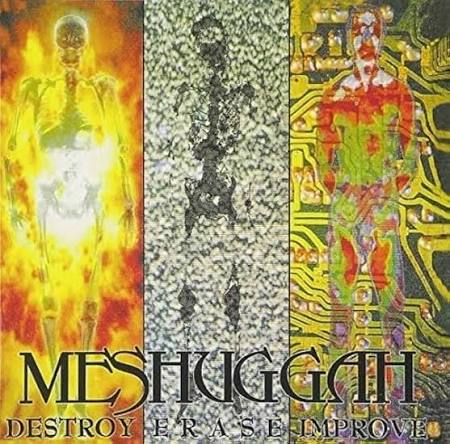
Destroy Erase Improve is Meshuggah’s second album, released by Nuclear Blast in 1995 after the debut Contradictions Collapse. The Umeå band starts from thrash metal and redefines its rhythmic grammar: riffs are built on cycles of irregular length, layered over an underlying pulse that stays almost fixed. The listener hears a steady beat and, above it, figures that keep shifting against the reference tempo. Tomas Haake’s drumming is the pivot of this mechanism. His dry sound and the precision of his detail give the tracks a gear-like motion, with every accent landing at a calculated point. Fredrik Thordendal’s and Mårten Hagström’s guitars lock tightly with the drums, while Jens Kidman’s monotone shout, free of melody, works as one more rhythmic component. On Future Breed Machine, Beneath and Vanished it is easy to hear how riffs are repeated and displaced slightly with each cycle. Thordendal’s solos are the element that departs from this structure. They lean toward jazz fusion, with angular phrasing and free use of the chromatic scale, and they stand apart from the rigidity of the surrounding material. The album therefore alternates strictly metric sections with moments of apparent improvisation, without the two ever merging. The production is fairly dry and keeps even the densest passages legible, although it sounds less massive today than on the band’s later work. The record connects naturally to the dossier High-Frequency Trading & Algorithmic Teleoplexy. Meshuggah’s music advances through iteration and calculation, at a speed that seems independent of any expressive intent. A self-feeding system that produces its effects through accumulated cycles is the same image the dossier describes for algorithmic markets. There is also an affinity with the Nick Land dossier, in the idea of processes that accelerate on their own and that the individual undergoes rather than directs. Destroy Erase Improve remains a reference point for rhythmic and mathematical metal, and its influence on the genre in the following decades has been wide. For readers arriving from the site’s other entries, it is a useful listen for observing how a mechanical aesthetic can emerge from traditional rock instruments.
The AI is relistening to the album for you...