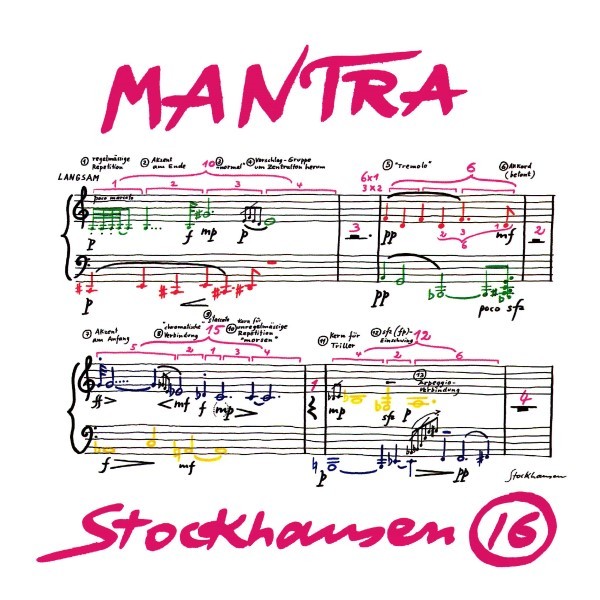
Mantra occupies a singular position in Stockhausen's catalogue: it is at once a turning point and a work of rare immediacy. Composed in 1970, it marks the German composer's return to fully notated writing after the era of "intuitive" works based on graphics and verbal instructions, and introduces for the first time the "formula" principle that would organise the entire Licht cycle in the following decades . But it is also—not a given with Stockhausen—a work that functions first and foremost in listening. The forces are what one expects from a score of this period: two pianos, live electronics (ring modulator), and small percussion—antique cymbals and Japanese wood blocks—played by the pianists themselves . The structure is built on a thirteen-note formula, organised into four mirroring elements, from which all the material of the hour-long work derives through expansion, transposition and transformation . It is a rigorous, almost mathematical architecture, yet the result is never arid: the two piano parts intertwine with a timbral and rhythmic variety that keeps the listening experience far from abstract. Critical reception has oscillated over time between suspicion of the theoretical apparatus and recognition of its sonic power. The New York Times, reviewing the New York premiere in 1984, described a work "by turn sprawling and concentrated, boring and engrossing, silly and profound" —a judgment that, forty years on, looks more inaccurate than ever. Recent performances, particularly those by the GrauSchumacher Piano Duo with the SWR Experimentalstudio, have shown that Mantra has accumulated no patina whatsoever: structural complexity does not prevent a sensual, almost theatrical listening of its continuous transformations . Stockhausen himself, after all, described the formula as a hybrid of mathematical notation and "magic formula" —and in Mantra the magical, ritual dimension is tangible. The limitation, if one can call it that, lies perhaps in length: seventy minutes of material expanding and contracting according to rigorous rules demands attentive listening, and not every section holds equally. But the final coda, which compresses the entire work into a few minutes of frantic activity, is one of the most successful passages in late-modernist repertoire . Mantra is neither Stockhausen's most radical work nor his most famous. It is, however, one of his most honest: a composer returning to writing notes, aware that structure is not an end but a means of generating sound. For those approaching Stockhausen without wishing to pass through the theology of Licht, it is a reasonable entry point—provided you have an hour to spare, and do not demand that the avant-garde always be immediately digestible.
The AI is relistening to the album for you...