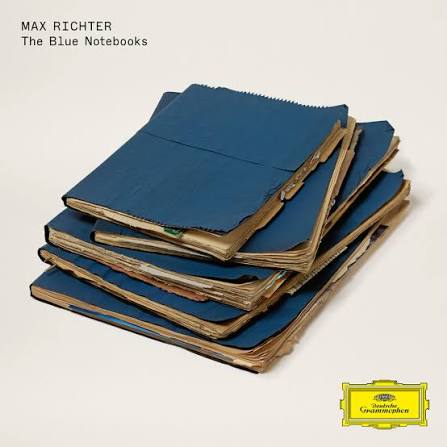
The Blue Notebooks is Max Richter’s second album, released in 2004 on the 130701 label, an imprint of FatCat. Richter came from an academic background (Edinburgh, the Royal Academy, studies with Luciano Berio) and from collaborations in electronic music, and on this record he combines strings, piano, electronic textures and spoken voice. The title refers to Franz Kafka’s octavo notebooks, from which part of the texts are drawn, alongside pages by Czesław Miłosz. The texts are read by Tilda Swinton in a neutral tone, almost free of inflection. The record has a fragmentary form: short pieces for piano and strings alternate with longer episodes, and the spoken sections slip in between the music without a real narrative frame. Horizon Variations opens with a slow pace and an electronic colour that is barely perceptible, while pieces such as Vladimir’s Blues and Shadow Journal work on a few repeated elements. The harmonic material is simple, built on diatonic progressions and a sparing use of pedal and strings, which tend to support rather than converse. The best-known piece is On the Nature of Daylight, a string elegy built on a progression that repeats and rises slowly. Its circulation in film and television has ended up overshadowing the rest of the album, which nonetheless has a more marked unity of tone than the single track suggests. Richter has linked the genesis of the work to the climate following the 2003 invasion of Iraq, and listening retains something of that context: the music neither comments nor describes, but stays in a state of waiting and restrained unease. Within Hyperstition.fm, the record connects to the Mark Fisher dossier (2). Swinton’s voice reading Kafka over a bed of strings produces the effect of an echo with no precise source, close to the spectrality Fisher describes for music that returns emptied of its historical moment. Its later fortunes, with On the Nature of Daylight now associated with dozens of scenes of mourning, also show how a piece can become a recognisable and almost impersonal emotional formula. A second possible link is to the Deleuze & Guattari dossier (12), for the use of repetition as a tool for dilating time. The record holds a stable place in the contemporary neoclassical repertoire, and for the site’s catalogue it adds a title to the classical/ambient section, which is still thinly represented.
The AI is relistening to the album for you...